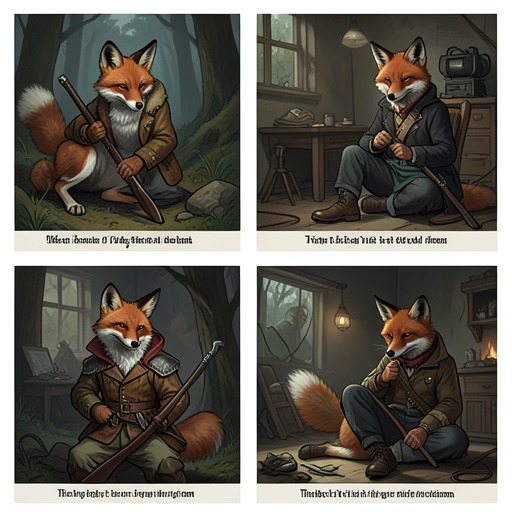
Fox
Aesop's FablesFox is one of the collection’s characteristic figures of cunning, a familiar animal persona used to expose human motives as well as to drive compact tales of deception and escape. He praises a Crow into dropping stolen meat, persuades a thirsty Goat to enter a well and then uses him as a means of escape, and answers a Bear’s self-congratulation with a pointed rebuke. These episodes give his cleverness different moral colors: it can puncture hypocrisy, but it can also serve his own advantage at another creature’s expense.
Identity and Fabulist Convention
The preface describes the Fox as an animal whose customary fictional character is cunning, alongside the timid Hare, bold Lion, cruel Wolf, strong Bull, proud Horse, and patient Ass. This convention makes the Fox immediately legible, but his role is not merely a fixed emblem: each story tests what cunning accomplishes and who bears its cost. The collection’s account of the fable explains that fictitious animals represent human motives while retaining recognizable animal traits; the moral is meant to arise from a simple action rather than from an accumulation of incidents.
That account also cautions that not every fable in the collection achieves the ideal unity between narrative and moral. The Fox therefore appears within a literary tradition that invites readers to compare a story’s action with its stated lesson, rather than assuming the closing maxim exhausts what the episode shows.
Escape and Exploitation
In the well episode, the Fox has fallen into a deep well and cannot find a way out. When a thirsty Goat arrives and asks about the water, the Fox conceals his predicament beneath a cheerful manner and praises it extravagantly. The Goat, intent on quenching his thirst, jumps down without first considering how either of them might get out. Only after the Goat drinks does the Fox disclose their shared difficulty and propose that the Goat brace his forefeet against the wall and bend his head.
The Fox then turns the Goat’s body into a route to safety: he runs up the Goat’s back, steadies himself on the Goat’s horns, reaches the mouth of the well, and leaves. When the Goat reproaches him for breaking his promise to help, the Fox retorts that the Goat should have inspected the way out before descending. The tale’s closing maxim, “Look before you leap,” directly warns against the Goat’s failure of foresight. Yet the action also exposes the Fox’s manipulation: he knowingly drew the Goat into danger and used the promised rescue to secure his own escape.
Flattery as a Weapon
In another tale, a Crow has stolen a piece of meat and is holding it in her beak while perched in a tree. The Fox wants the meat, so he praises the Crow’s shape and complexion, then suggests that a voice to match her appearance would make her Queen of Birds. Eager to disprove the implied criticism, the Crow caws; the meat falls, and the Fox takes it. His final rebuke—that her voice is adequate but her wit is not—makes the trick’s mechanism plain: praise prompts the very display that costs the Crow her prize.
The preface singles out this episode as an example of a moral embedded in the action: when the Crow drops the meat, the warning against flattery falls with it. The Fox’s eloquence is not simply decorative; it is the instrument by which he turns vanity into a material gain. The episode also shows how a short narrative can make its lesson legible without relying solely on an appended explanation.
Rebuke and the Limits of the Moral
The Fox’s wit takes a different direction in his exchange with the Bear. The Bear boasts that he is exceptionally considerate toward people because he will not touch a dead body. The Fox responds with a smile, wishing that the Bear would eat the dead rather than the living. His brief answer turns the Bear’s claim of philanthropy against him: abstaining from one kind of predation does not make the Bear benevolent toward those still alive.
This scene differs sharply from the well and the stolen meat. There, the Fox’s cleverness secures his own escape or advantage; here, it exposes another animal’s self-serving account of his conduct. Together, the tales make cunning a flexible narrative instrument rather than an uncomplicated virtue. The Fox fits the collection’s conventional image of the crafty animal, but the consequences of his craft—and the moral judgment attached to it—depend on whom he deceives and what his deception reveals.
A Type with Political Reach
The collection’s preface presents fables as short narratives that conceal instruction in the actions of fictional characters, allowing readers to receive counsel without an overt adviser. It also notes that some fables may have begun as responses to particular wrongs or occasions, while remaining capable of teaching lessons of wider application. The Fox’s role suits that form: a flattering speech, a step into a well, or a sharp reply can turn an abstract judgment about vanity, foresight, or hypocrisy into a visible consequence.
The preface further associates the Fox with the customary trait of cunning, while emphasizing that fables represent human passions through animal characters. His episodes thus operate at once as animal stories and as compact judgments about human behavior: persuasive praise can conceal self-interest, failure to plan can leave someone dependent on another’s scheme, and a claim to virtue can collapse under a pointed comparison. The Fox’s recurring significance lies in that range—he is at once an exploiter, an escape artist, and a critic who makes concealed motives difficult to ignore.